


 Quality Assurance Methods and Proficiency Testing
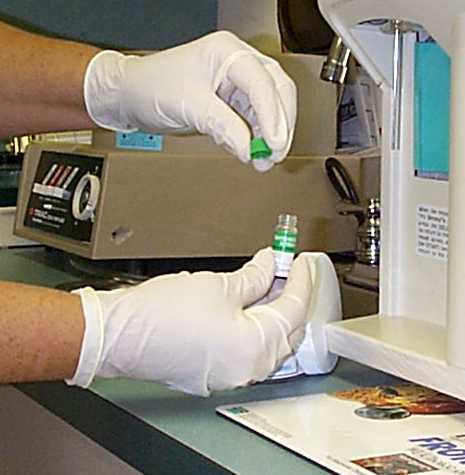
 for the Office Laboratory Barry T. Mitzner, D.V.M During the last twenty years or so, the veterinary market for in-house testing instrumentation has enjoyed nothing less than spectacular growth. Where in-house laboratory equipment was once considered a luxury affordable only to well-established practices, veterinarians just starting out are now incorporating the cost of in-house laboratory equipment into their start-up budgets. And why shouldnt they? Given the advancements in analyzer technology fueled by the availability of faster and cheaper microchips, veterinarians are receiving more for their laboratory equipment dollar today than ever before. Couple that with the fact that fees for these services have risen steadily in most areas while pet owners have become more accepting of laboratory testing, and its easy to understand why so many manufacturers are vying feverishly for a share of this market. An Idea Whose Time Has Come The purpose of a laboratory quality assurance program is to monitor overall laboratory performance and to assure the clinician that test results generated by the laboratory are both accurate and precise. With more practices performing in house testing than ever before, the immediate need for such programs has never been greater. Unfortunately the importance of quality control has been glossed over by so many laboratory equipment companies that veterinarians have been lulled into believing that QA programs are built into systems at the manufacturer level or represent unnecessary effort and expense. While the veterinary diagnostics industry has spent millions to develop increasingly user-friendly analytical systems, easy-to-use doesnt equate to goof-proof. In fact, the more automation thats built into a system, the more important it becomes for testing procedures to be followed exactly. While medicine is hardly an exacting science and often patients will recover whether practitioners do the correct thing or not, laboratory testing doesnt work that way; do it wrong and it comes out wrong each and every time! The most common causes for erroneous laboratory results include operator/protocol errors, specimen abnormalities, reagent problems, and instrument failure. A properly administered quality assurance program will assess performance in each of these areas as well as the testing system as a whole. QA programs are built around QC materials, which must be formulated to mimic an actual patient specimen. In so doing, the QC material will not only check the overall function of the analyzer or test kit itself, but also operator protocol and reagent integrity. Such novel QC devices as calibration tubes and so-called smart quality controls only accomplish part of the job. Periodically sending comparison specimens to an outside laboratory wont do the entire job either. Hematology QC Methods Whether CBCs are being performed manually or with the help of an instrument, its important to have in place some method for validating that the results obtained from patient specimens are accurate. Pre-assayed blood samples, otherwise known as quality control products, are widely available throughout the human-side hematology market. With the exception of Multi-Trol® (a veterinary product), all of these control products are made by and for the human testing market. When used in the veterinary setting, however, most of these products will provide adequate performance checks on the instrument, reagent system, specimen dilution, preparation, and operator protocol. Users of human side control products should carefully review the enclosed package insert to determine if the product contains any human material. If so, operators should wear disposable gloves as a precautionary measure when handling. Serum Chemistry QC Methods While serum biochemistry testing was once almost the exclusive domain of the reference laboratory, many practices are regularly performing such testing with the help of a variety of high-tech, user-friendly desktop analyzers. Employing both dry and wet chemistry methodologies and offering everything from single tests to full profiles and electrolytes, this class of analyzer has become a mainstay for many practices. Unfortunately, well meaning, albeit overzealous, salespeople who sometimes lack proper laboratory training are aggressively selling many of these analyzers to practitioners as foolproof products. Among the common mistakes we've observed in and around veterinary practices are improperly stored reagent kits, tests run with expired reagents, non-existent instrument maintenance programs, and unorthodox pipetting techniques. Weve also observed personnel attempting to run lipemic, hemolyzed, or icteric specimens with no respect to or understanding of how these artifacts might alter the final patient results. In almost every case, the busy practitioner was unaware that such mishaps were occurring. A quality assurance program, however, could have identified many of those errors. Chemistry control solutions are used for this procedure and these products consist of either freeze-dried or ready-to-use serum which has been carefully assayed for all constituents and whose published acceptable response ranges are listed and packaged along with the product. When the laboratory is able to recover those target values utilizing its own equipment, technicians, and reagents, the veterinarian can be quite confident with respect to the accuracy of his or her patient results and can rely upon them for establishment of a diagnostic and therapeutic plan. Microbiology and Quality Control Although most veterinary practices today have ready access to outside laboratories for culture and sensitivity work, some practices still prefer to run these procedures in the office. In-house bacterial culture and sensitivity testing, however, should only be performed under the auspices of a properly maintained QC program. Among the items, which must be routinely checked, are incubator and refrigerator temperature (monitor and record daily), agar plate quality (inspect upon arrival for expiration, hydration, cracks, and general condition), and agar sterility (incubate one plate from each shipment 24 hours at room temperature and again at 37 degrees). The performance of identification products, reagents, and kits should also be validated through the periodic assay of known specimens. Of all of the commonly practiced in-house bacteriology procedures, the Kirby-Bauer method for antibiotic susceptibility testing is the one most prone to error. In order for susceptibility results to be meaningful, the organisms to be plated must be in pure culture and diluted using a 0.5 McFarland Standard. The susceptibility agar medium must be of a variety capable of sustaining growth of the organism under investigation and must be adequately hydrated to allow proper diffusion of the antibiotic. Most importantly, each zone of inhibition must be measured using a caliper or ruler and compared to published inhibitory values for each antibiotic. Only then can a correct determination of in-vivo susceptibility be made. Some practices also utilize Gram stains either as a primary diagnostic procedure or as an adjunct to culture and sensitivity testing. Although the basic Grams procedure is rather straightforward, many clinicians dont realize how easily the final results can be altered through mistakes in protocol. One of the simplest ways to QC this procedure is to utilize either prepared Gram QC slides or known Gram positive and Gram negative organisms obtainable from many laboratory supply houses. Gram QC slides consist of standard microscope slides to which have been permanently fixed standardized suspensions of known unstained organisms. Samples of the organism(s) under investigation can be applied to these slides and stained by the laboratorys usual protocol, allowing the clinician to compare the color (Grams) reaction of unknown to known organism. QA for Urinalysis The urinalysis procedure can be quality assured by using either reconstituted freeze-dried stabilized urine controls or those, which are packaged in a ready-to-use form. Remember that refractometers can go out of calibration, dip strips can be damaged by humidity when vials are carelessly left open, and sediments can be prepared incorrectly by too much or too little centrifuging. If the lab can recover the target assay values for the urine control, the practitioner can be assured of the accuracy of his or her patients test results. QA for Immunodiagnostic Kit Testing This testing modality has become commonplace in veterinary practice and a variety of kits are now available for the testing of dogs, cats, large animals and even some exotics. In addition, there are a number of test kits which have come over from the human side and which have demonstrated reasonably good results when run with animal specimens. In virtually all cases, some type of quality control is furnished with or included as part of the kit; either built directly into the test device or provided as a separate solution. A word of caution is in order, however. Controls, which are built into test devices, are usually procedural controls and their utility is limited to confirming that each step of the test procedure has been performed correctly. Procedural controls do not, however, confirm that the test system is actually detecting either the infectious agent or the antigen in question. This function can only be verified by testing against a control prepared from a suspension of the actual organism or antigen itself. How Often Should I Run Controls? Many practitioners erroneously believe that the frequency with which quality controls should be run is somehow tied to the specific product, analyzer, or test system by the manufacturer. Since we've already stated that quality control is a means for validating the overall performance of a given testing system, the answer to this question actually lies entirely with the practitioner who should base that decision upon the level of confidence in patient test results that is appropriate to his or her practice. Bear in mind, however, that once a control run indicates that an instrument, reagent, or protocol problem exists, only patient results obtained prior to the last acceptable quality control run can be considered valid. Proficiency Testing Proficiency testing is a procedure performed by all physician offices that run patient tests on site and subscription to a proficiency program is a requirement for physician laboratory licensing and renewal. Such programs compare the laboratory performance of one lab to other similar offices and in so doing assures the public that no matter where one goes for testing, the results and clinical impression will remain the same. As a subscriber to a laboratory proficiency program, physician offices are periodically sent several unknowns for each department for which the office laboratory is licensed. Laboratory personnel are required to run these unknown specimens and report their final results back to the sponsoring agency for tabulation. Once all labs within the program have reported, a performance curve is set up and any offices whose results fall outside the acceptable range prescribed by that curve are warned to correct their deficiencies or lose the privilege to perform further patient testing. Two successive failures will result in forfeiture of that office's laboratory license requiring the practice to apply for recertification. The office must pass both a site inspection and examination by an agency-appointed laboratory inspector in order to regain licensure. Since veterinary laboratories are still unregulated, there is no such proficiency requirement for licensure. Veterinary proficiency programs, however, do exist although the profession has been slow to embrace them. Perhaps practitioners should rethink this position and consider how mandatory government intervention in the name of protection for the pet-owning public might take away much of the freedom and autonomy they now enjoy.
References and Additional Reading: Vap, Linda M. and Barry T. Mitzner: An Update on Chemistry Analyzers. Veterinary Clinics of North America, Vol 26:5 pp. 1129-1154; 1996 Mitzner, Barry T: Quality Control Procedures for the Avian Practice Laboratory. Journal of Avian Medicine and Surgery 12(1):36-40, 1998 |
Copyright © Vetlab Supply, Inc, All rights reserved.